What if freedom began with one step?
AI-generated concept film. An imagined future, not a demonstrated treatment.
Read the visual story
Samira rests in bed wearing the imagined LUMA headpiece. A winged exoskeleton appears. The film imagines her standing, moving towards Diana for a kiss, and looking out towards the world.
To move towards someone you love. To meet the world at eye level. To have a little more say in where your day takes you.
Inspired by Samira, LUMA asks what might become possible when wearable robotics, AI and a deeply personal understanding of care come together.
Concept stage. We are seeking research and engineering collaborators to investigate the possibilities.
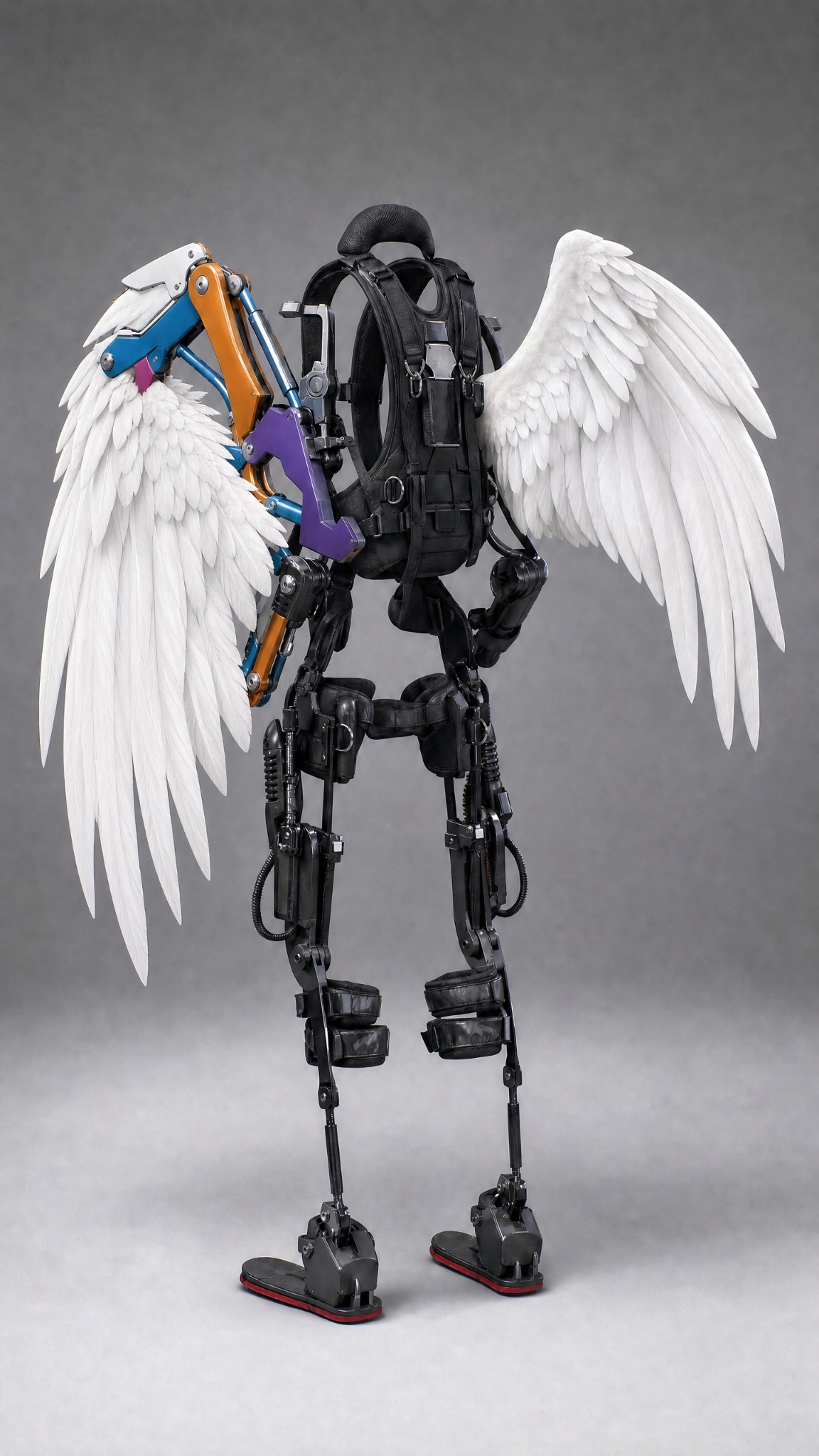
Concept artwork. The wings carry the visual language of the Wings of Ash logo: care and technology supporting the same person.



A kiss.
A window.
A world to move towards.
The heart of this film is a small, ordinary moment: Samira moving closer to her mother. A moment that asks an extraordinary question.
What if technology could give someone with complex motor disabilities more choice, more supported movement, or a different way to take part in everyday life?
Would that be worth exploring?
We believe it would.
Samira lives with severe cerebral palsy, epilepsy and complex motor and communication support needs. She relies on a wheelchair and extensive daily assistance. Those needs must shape the research from its very first question.
That is where LUMA begins. With Samira’s dignity, comfort and choices at the centre. Freedom can mean assisted steps, powered mobility, easier communication, or simply choosing what happens next.
The suit brings the Wings of Ash symbol into physical form. One wing is feathered. The other reveals the engineering beneath it. Together, they express the purpose of this vision: building support around the person.
What would it take
to make movement possible?
An AI-powered exoskeleton is a wearable robotic system that can assist movement through powered joints, sensors and control software. In our proposed architecture, LUMA is the sensing and intelligence layer connecting the person, the wearable and the care team.
This is a research direction. The integrated system shown in the film has not been built or clinically validated.
01LUMA: listening before moving
The slim headpiece is an industrial-design concept for a non-invasive interface. A research version could investigate scalp EEG alongside eye tracking, accessible switches, surface EMG and motion sensors. EEG measures electrical activity at the scalp; EMG measures muscle activity. They provide different kinds of information.
- Neural interface: investigate whether reliably distinguishable signals can support simple, intentional commands. Electrode placement, hair, skin contact, motion artefacts and individual calibration would determine feasibility.
- Multiple ways to choose: if EEG is unreliable or unsuitable, an eye-gaze selection, switch or caregiver-assisted command could be a better access method.
- A slim shape is not a validated sensor: the luminous forehead element is a visual identity. It does not establish that the required brain signals can be captured from that location.
Research context: a preliminary study tested EEG-based exoskeleton commands in five adults with spinal cord injury during crutch-assisted walking. It does not establish suitability for children with cerebral palsy. Read source 3.
02The exoskeleton: support for the whole person
Moving a leg is only one part of supported walking. A system for someone with very limited motor control would also need to address the pelvis, trunk and head, body-weight support, transfers, joint alignment and stability.
- Sensing: joint encoders, inertial measurement units and foot-contact or load sensors could describe posture and loading.
- Assistance: controlled actuators could support selected joints within clinician-defined movement and force limits.
- Stability: a gait-trainer frame or other external support may be necessary. Free-standing balance cannot be assumed from powered legs.
- Fit and comfort: the design must accommodate growth, skin pressure, range of motion, fatigue, swallowing or breathing considerations, and each person’s clinical needs. Epilepsy and involuntary movements would require an individual clinical risk assessment and an appropriate stopping and support plan.
Pediatric exoskeleton research includes children who already walk, while a separate GMFCS V case report describes a supported robotic gait trainer. These are different devices and different evidence bases. Source 1 · Source 2.
03AI: personalisation within firm boundaries
The proposed AI layer would combine available signals to estimate activity, signal quality and a small set of user-selected intentions. It could help clinicians study patterns and adapt assistance. Every prediction would remain uncertain.
- Signal confidence: uncertain or conflicting inputs must not become an automatic instruction to step.
- Shared control: an accepted high-level request would pass to a separately engineered movement controller that checks posture, contact and permitted actions.
- Independent protection: force and speed limits, emergency stopping, safe handling of power or connection loss, and caregiver override must not depend on a language model.
- Privacy: minimise recordings, restrict access and favour local processing where practical. A research dataset would require appropriate consent and governance.
These are proposed design requirements for LUMA, not capabilities demonstrated by the film.
04Humanoid robotics: a separate kind of support
An exoskeleton is worn by the person. A humanoid is a separate robot working nearby. A future care environment could explore robotic assistance with fetching objects, presenting communication tools or supporting a caregiver’s workflow.
Physical assistance would need task-specific validation. Autonomous lifting, transfers, catching a fall or supervising a vulnerable child cannot be assumed safe because a robot looks human. Early research could use controlled tasks, simulation and teleoperation with an accountable human operator.
The priority would be useful assistance around the family, with clear limits on what the robot is allowed to do.
Background reading: Teleoperation of Humanoid Robots, source 5. The LUMA applications above are our proposed research directions, not results from that paper.
A possibility to investigate.
A person to understand.
GMFCS V describes a level of gross motor function in cerebral palsy associated with extensive support needs, including head and trunk positioning and mobility. It is not a measure of a person’s worth or a forecast of every meaningful experience they can have.
GMFCS V is discussed here as research context, not as a confirmed classification for Samira. Her clinical classification would need to be established from her medical records by her care team.
For this group, the first research question is whether an intervention is appropriate, tolerable and useful for the individual. Supported activity and participation may be meaningful outcomes even when independent walking is not achievable.
Research in spinal cord injury cannot simply be transferred to cerebral palsy. Likewise, results from children who already walk cannot be assumed to apply to someone with much greater support needs.
Supported stepping has been studied.
One report followed a seven-year-old child using a robotic gait trainer for three months. It is a reason to investigate supported mobility, not proof of independent walking or of LUMA’s effectiveness.
The vision is ready to ask better questions.
We have a visual concept and a story that makes the goal tangible. Engineering feasibility, usable signals, clinical suitability and real-world outcomes still need to be established.
No clinical results, device certification or research partnerships are being claimed.
Begin with care.
Earn every next step.
A credible programme would build evidence in stages, with families, clinicians and engineers deciding together what success should mean.
Start with the person.
Map communication access, comfort, positioning and daily goals. Establish clinical suitability and measurable outcomes before choosing hardware.
Prove the components.
Test sensing, mechanical fit, support, failure handling and stopping on the bench and in simulation. Document limits before any participant testing.
Validate with supervision.
Only after appropriate review and approvals, investigate feasibility with trained teams. Report usability, comfort, safety and participation as well as movement.
LUMA is a proposed integrated concept. Explore NeuroWeave and our wider R&D work.
Help turn a moving story
into a serious research question.
We welcome conversations with pediatric rehabilitation teams, neurotechnology researchers, robotics engineers and thoughtful funding partners. Bring a question, a skill, or a reason to explore what greater freedom could mean.
Explore a collaboration ↗Partnerships: partnership@wingsofash.de
General information: Diana@wingsofash.de
Research behind the questions
- NIH: wearable robotic assistance for crouch gait in children with cerebral palsy. Research in children able to participate in walking; not evidence for LUMA.
- Diot et al.: robotic lower extremity exoskeleton use in a non-ambulatory child with cerebral palsy. A single GMFCS V case study, not a controlled trial.
- Kim et al. (2026): motor-imagery BCI control of an exoskeleton. Preliminary work in five adults with spinal cord injury.
- CanChild: Gross Motor Function Classification System, Expanded & Revised. Classification context for the discussion of support needs.
- Darvish et al.: Teleoperation of Humanoid Robots, a survey. Technical background on human-operated robotic systems.
Film and suit imagery are conceptual visualisations. This page presents a proposed research direction, not a treatment offer or an individual clinical recommendation. LUMA is an original Wings of Ash concept and is not affiliated with Neuralink. Research context reviewed 24 October 2026.